
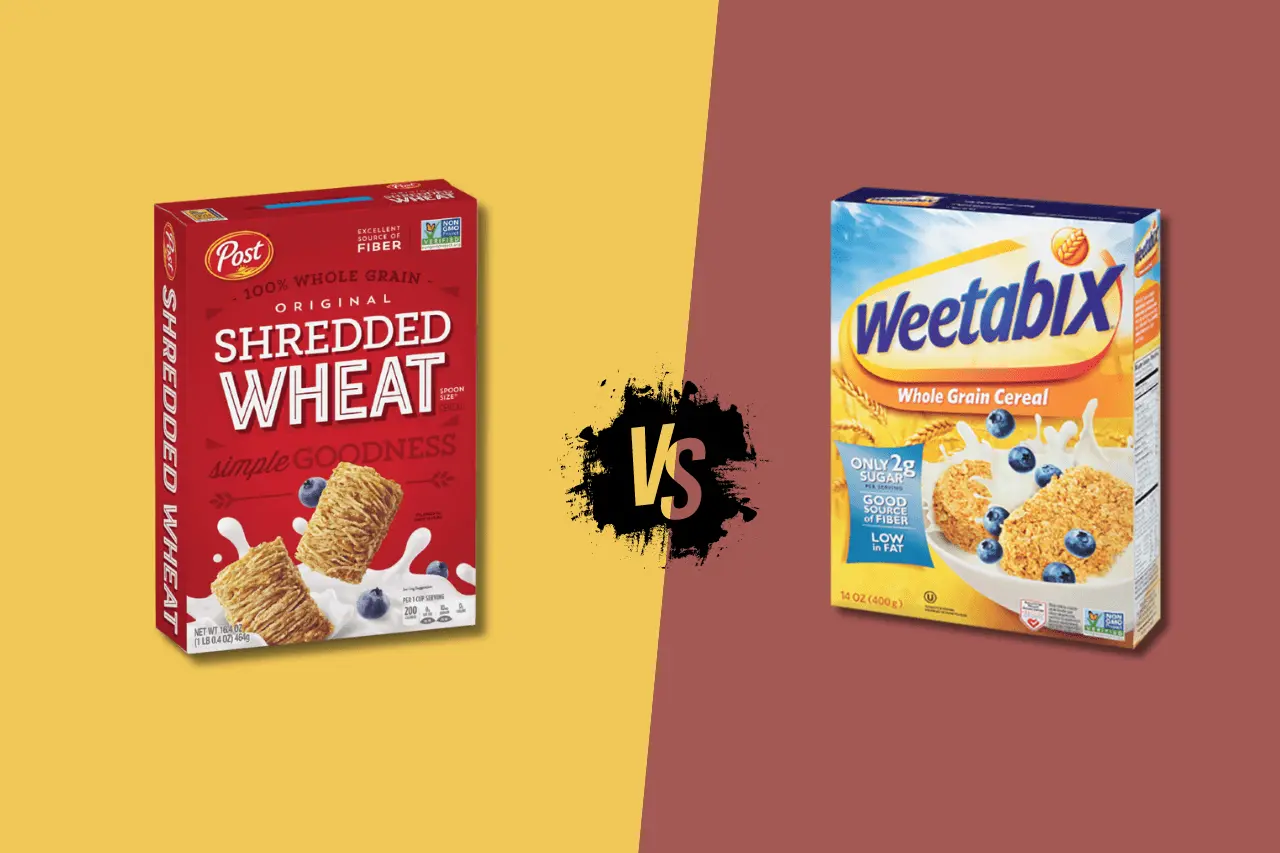
You’re standing in the cereal aisle, holding a box in each hand. Shredded Wheat in your left. Weetabix in your right.
Both look virtually identical—brown wheat biscuits, whole grain labels, minimal ingredients, no flashy cartoon characters. They’re positioned as the “healthy adult choice” compared to the sugary cereals dominating the rest of the aisle.
But here’s your dilemma: they seem almost the same. Both are whole wheat. Both claim to be nutritious breakfast staples and have been around for decades.
So which one is actually healthier? And more importantly—are EITHER of these as good for you as the packaging suggests?
You’re not alone in this cereal confusion. Shredded Wheat (made by Post) and Weetabix (made by Weetabix Limited) have been breakfast table staples for generations—Weetabix dominates UK breakfast tables, while Shredded Wheat is an American classic.
But when you compare them ingredient-by-ingredient and nutrient-by-nutrient, one clearly edges out the other. And spoiler alert: even the “winner” isn’t quite the nutritional powerhouse the marketing wants you to believe.
The honest truth? Shredded Wheat is nutritionally superior to Weetabix—zero sugar, zero sodium, higher protein and fiber, more vitamins and minerals. But both are still processed cereals that are “better than Froot Loops” rather than “optimal breakfast choices.”
In this comparison, I’ll break down exactly how these wheat biscuits stack up, which one wins the nutrition battle, and whether either deserves a permanent spot in your morning routine.
What Exactly Are These Cereals?
Before we dive into the showdown, let’s establish what we’re actually comparing.
Shredded Wheat (Post)
Shredded Wheat is as simple as breakfast cereals get. It’s literally whole wheat that’s been cooked, shredded into thin strands, and formed into pillow-shaped biscuits.
Available varieties:
- Original – Just whole grain wheat, nothing else
- Big Biscuit – Same formula, larger size
- Wheat ‘n Bran – Whole grain wheat plus wheat bran for extra fiber
The ingredient list is famously minimal. In fact, the original and Big Biscuit versions contain exactly ONE ingredient: whole grain wheat.
That’s it. No sugar. No salt. No oils. Just wheat.
(Note: The packaging contains BHT to preserve freshness, but it’s not added to the cereal itself—it’s in the packaging material only.)
Weetabix (Weetabix Limited)
Weetabix follows a similar whole wheat concept but takes a slightly different approach. These British breakfast biscuits are made from whole grain wheat but include a few additional ingredients.
Popular in: Primarily UK, but available internationally
Varieties available: Original, Chocolate, Banana, Protein, and more
For this comparison, we’re focusing on Weetabix Original—the classic version.
Ingredients: Whole grain wheat, malted barley extract, sugar, salt, plus fortification with iron, niacin (B3), and thiamin (B1).
UK vs US difference: Weetabix sold in the UK uses table sugar instead of cane sugar and is fortified with additional nutrients like riboflavin and folic acid.
The Ingredient Showdown
Let’s compare what you’re actually eating.
Shredded Wheat Ingredients:
- Whole grain wheat
- BHT (in packaging only, not in cereal)
That’s literally it. One ingredient. You cannot get more minimalist than this.
Weetabix Ingredients:
- Whole grain wheat
- Malted barley extract (a type of sugar)
- Cane sugar
- Salt
- Iron (fortified)
- Niacin/B3 (fortified)
- Thiamin/B1 (fortified)
What this means:
Both cereals start with whole grain wheat as the foundation—that’s good. Whole grains provide fiber, B vitamins, minerals, and sustained energy.
However, Weetabix adds sugar (both cane sugar AND malted barley extract, which is also a sugar source), plus salt. These additions aren’t terrible—2g sugar and 190mg sodium per serving is relatively low—but they’re still additions that Shredded Wheat doesn’t need.
The verdict: Shredded Wheat wins on ingredients. It’s cleaner, simpler, and contains zero added sugar or sodium. If you’re a purist who wants minimal processing, Shredded Wheat is your cereal.
The Nutrition Battle: Breaking Down the Numbers
Now let’s get into the real comparison—the nutrition facts.
Note: Shredded Wheat serving size is 60g (about 2 biscuits). Weetabix serving size is 53g (about 2 biscuits). Keep this slight difference in mind when comparing.
Calories
| Cereal | Calories per Serving |
|---|---|
| Shredded Wheat (60g) | 210 |
| Weetabix (53g) | 180 |
Winner: Weetabix (by 30 calories)
But here’s the important question: where do these calories come from?
Shredded Wheat calorie breakdown:
- 28 calories from protein
- 32 calories from fiber
- 136 calories from complex carbs
- Rest from minimal fat
Weetabix calorie breakdown:
- 20 calories from protein
- 24 calories from fiber
- 8 calories from added sugar
- Rest from carbs and fat
Shredded Wheat has a slightly better calorie profile—more protein, more fiber, zero sugar. Weetabix is lower in total calories, but those calories are less nutritionally dense.
Sugar
| Cereal | Sugar per Serving |
|---|---|
| Shredded Wheat (60g) | 0g |
| Weetabix (53g) | 2g |
Winner: Shredded Wheat (by a landslide)
Shredded Wheat contains ZERO added sugar. None. Nada. The only sweetness comes from the natural sugars in wheat itself (minimal).
Weetabix contains 2g of added sugar per serving—not a lot by cereal standards, but still added sugar that you don’t need.
Reality check: 2g sugar is genuinely low for a breakfast cereal. Most cereals have 10-15g per serving. So even though Shredded Wheat wins, Weetabix isn’t a sugar bomb by any means.
Protein
| Cereal | Protein per Serving |
|---|---|
| Shredded Wheat (60g) | 7g |
| Weetabix (53g) | 5g |
Winner: Shredded Wheat
Shredded Wheat packs 40% more protein than Weetabix (7g vs 5g). That’s significant for a breakfast cereal.
The protein in both is plant-based (from wheat), making them suitable for vegans and vegetarians. However, wheat protein isn’t a complete protein—it’s low in lysine, an essential amino acid.
What this means: Neither cereal alone provides complete protein. Pair them with milk, yogurt, or nuts to get all essential amino acids.
Fiber
| Cereal | Fiber per Serving |
|---|---|
| Shredded Wheat (60g) | 8g (1g soluble, 7g insoluble) |
| Weetabix (53g) | 6g (2g soluble, 4g insoluble) |
Winner: Depends on your needs
Shredded Wheat provides 33% more total fiber (8g vs 6g)—that’s excellent. The fiber is primarily insoluble (7g), which is great for digestive health, regularity, and adding bulk to stool.
Weetabix has less total fiber but provides a higher proportion of soluble fiber (2g vs 1g). Soluble fiber helps lower cholesterol and stabilize blood sugar.
The verdict: If you need more fiber overall or struggle with constipation, Shredded Wheat wins. If you’re targeting cholesterol reduction or blood sugar control, Weetabix’s soluble fiber ratio is slightly better.
But honestly? Both are good fiber sources. You can’t go wrong with either.
Sodium
| Cereal | Sodium per Serving |
|---|---|
| Shredded Wheat (60g) | 0mg |
| Weetabix (53g) | 190mg |
Winner: Shredded Wheat
Shredded Wheat takes the zero-sodium approach. Perfect for anyone monitoring salt intake or following a low-sodium diet.
Weetabix contains 190mg sodium per serving—still considered low (8% of daily limit), but not ideal if you’re trying to minimize sodium.
Why this matters: Most people already get too much sodium from processed foods. Starting your day with zero-sodium cereal gives you more room for sodium later without exceeding healthy limits.
Fat
| Cereal | Fat per Serving |
|---|---|
| Shredded Wheat (60g) | 1.5g |
| Weetabix (53g) | 1g |
Winner: Essentially tied
Both are extremely low in fat. Neither contains saturated fat or trans fat. The minimal fat present comes naturally from the wheat germ.
This is a non-issue for both cereals.
Vitamins & Minerals
Here’s where things get interesting.
| Nutrient | Shredded Wheat (% DV) | Weetabix (% DV) |
|---|---|---|
| Iron | 10% | 40% |
| Zinc | 20% | Not fortified |
| Vitamin B1 (Thiamin) | 10% | 90% |
| Vitamin B2 (Riboflavin) | 6% | Not fortified |
| Vitamin B3 (Niacin) | 20% | 15% |
| Vitamin B6 | 6% | Not fortified |
| Vitamin B9 (Folate) | 6% | Not fortified |
| Magnesium | 15% | Not fortified |
| Phosphorus | 20% | Not fortified |
| Potassium | 6% | 5% |
Winner: Shredded Wheat (overall)
Weetabix is heavily fortified with iron (40% DV) and thiamin (90% DV), which is great if you’re deficient in these nutrients.
However, Shredded Wheat provides a broader range of naturally-occurring vitamins and minerals—zinc, magnesium, phosphorus, B2, B6, B9—nutrients that Weetabix simply doesn’t have (or has in lower amounts).
The verdict: If you need iron or thiamin specifically, Weetabix is better. For overall micronutrient diversity, Shredded Wheat wins.
The Taste & Texture Factor (Let’s Be Honest)
Nutrition matters, but so does whether you’ll actually eat these cereals consistently.
Shredded Wheat:
- Taste: Very mild, wheaty flavor. Bland on its own (some say cardboard-like).
- Texture: Stays crunchy in milk for several minutes. Doesn’t get soggy quickly.
- Best served with: Sliced banana, berries, honey, or a sprinkle of cinnamon to add flavor.
Weetabix:
- Taste: Slightly sweeter than Shredded Wheat (thanks to added sugar). Still pretty bland.
- Texture: Gets soft and mushy within 30-60 seconds of adding milk. British people love this; Americans often find it unappealing.
- Best served with: Mashed with milk into porridge-like consistency (traditional British way), topped with fruit.
The cultural divide:
Brits LOVE the mushy Weetabix texture—it’s nostalgic, comforting, reminiscent of porridge. Americans typically prefer cereals that stay crunchy, making Shredded Wheat more appealing.
Reality check: Both cereals are quite bland on their own. Most people add fresh fruit, honey, yogurt, or nuts to make them palatable. That’s not a bad thing—it encourages adding nutritious toppings—but don’t expect explosive flavor from either one.
Practical Uses: Which Cereal for What?
Both cereals work for different situations.
Choose Shredded Wheat if you:
✅ Want zero added sugar
✅ Follow a low-sodium diet
✅ Need maximum protein and fiber
✅ Prefer cereal that stays crunchy
✅ Want minimal processing (one ingredient!)
✅ Are watching your weight (more filling)
Choose Weetabix if you:
✅ Need extra iron (great for anemia)
✅ Want more thiamin/B1
✅ Prefer slightly sweeter taste
✅ Love mushy cereal texture
✅ Can’t find Shredded Wheat (UK availability)
✅ Want a cereal that dissolves into milk easily
For Weight Loss:
Winner: Shredded Wheat
Higher fiber (8g) and protein (7g) means better satiety. You’ll stay full longer, reducing mid-morning snack cravings. Zero sugar also helps avoid insulin spikes.
For Kids:
Winner: Weetabix (slight edge)
The 2g of added sugar makes it more palatable for kids who might find plain Shredded Wheat too bland. However, both require toppings (fruit, honey) to make them kid-friendly.
For Athletes:
Winner: Shredded Wheat
More protein, more fiber, more calories, more micronutrients—better fuel for active individuals.
For Diabetics:
Winner: Shredded Wheat
Zero sugar and higher fiber content make it better for blood sugar management. Both have a relatively low glycemic index, but Shredded Wheat is the safer choice.
The Bigger Question: Are These Actually Healthy?
Here’s the reality check nobody else will give you:
Both Shredded Wheat and Weetabix are better-than-average cereals, but they’re still processed foods with limitations.
What they do well:
✅ Whole grain base (complex carbs, fiber, B vitamins)
✅ Minimal ingredients (especially Shredded Wheat)
✅ Low or zero added sugar
✅ No artificial colors, flavors, or preservatives
✅ Decent fiber content
✅ Vegan-friendly
What they lack:
❌ Complete protein (low in lysine)
❌ Healthy fats (need to add nuts, seeds, or nut butter)
❌ Vitamins A, C, D, E (need fruit or fortified milk)
❌ Fresh, whole-food nutrition
❌ Flavor without additions
The bottom line: Both cereals are solid breakfast options—certainly better than Lucky Charms, Froot Loops, or Frosted Flakes. But they’re not nutritional superstars.
For optimal breakfast nutrition, you’d still be better off with:
- Steel-cut oatmeal with nuts and berries
- Greek yogurt with granola and fruit
- Eggs with whole grain toast and avocado
- Protein smoothie with greens, fruit, and nut butter
However, if you’re choosing between these two wheat cereals, Shredded Wheat is nutritionally superior.
Frequently Asked Questions
Which is healthier, Shredded Wheat or Weetabix?
Shredded Wheat is nutritionally superior. It has zero sugar, zero sodium, more protein (7g vs 5g), more fiber (8g vs 6g), and a broader range of vitamins and minerals. Weetabix is still healthy but not quite as clean.
Can I eat Shredded Wheat or Weetabix every day?
Yes, both are safe for daily consumption. They’re whole grain cereals with minimal processing. Just make sure to add toppings (fruit, nuts, milk) for complete nutrition.
Which tastes better, Shredded Wheat or Weetabix?
Taste is subjective, but most people find both quite bland on their own. Weetabix is slightly sweeter due to added sugar. Both need toppings (fruit, honey) to taste good.
Are Shredded Wheat and Weetabix good for weight loss?
Yes, both can support weight loss due to high fiber content and relatively low calories. Shredded Wheat is slightly better (more fiber and protein for satiety, zero sugar).
Do Shredded Wheat and Weetabix have gluten?
Yes, both are made from wheat and contain gluten. They are NOT suitable for people with celiac disease or gluten sensitivity.
Are these cereals vegan?
Yes, both Shredded Wheat and Weetabix are 100% plant-based and vegan-friendly. However, most people serve them with dairy milk, so use plant milk if you’re vegan.
Which has more fiber?
Shredded Wheat has more total fiber (8g vs 6g). However, Weetabix has a higher proportion of soluble fiber, which is better for cholesterol and blood sugar control.
Can diabetics eat these cereals?
Yes, both are suitable for diabetics. Shredded Wheat is the better choice due to zero sugar and higher fiber. Always pair with protein and healthy fats to minimize blood sugar spikes.
Which is cheaper?
Prices vary by location and store, but generally they’re similarly priced. Both are budget-friendly cereals.
Where can I buy these?
Shredded Wheat is widely available in the US (most supermarkets). Weetabix is standard in UK supermarkets and available in international sections of US stores or online.
The Final Verdict: Which Should You Choose?
Let me be absolutely clear: Shredded Wheat is the healthier cereal.
Why Shredded Wheat wins:
Zero added sugar
Zero sodium
More protein (7g vs 5g)
More fiber (8g vs 6g)
Cleaner ingredients (just wheat!)
More vitamins and minerals overall
Better for weight loss, low-sodium diets, and blood sugar control
However, Weetabix has its place:
Higher iron content (great for anemia)
More thiamin/B1
Slightly sweeter taste
More widely available in the UK
Traditional British breakfast staple
My honest recommendation:
If both are available and similarly priced, choose Shredded Wheat. It’s nutritionally superior in almost every category.
But if you’re in the UK and Weetabix is what’s available (or what you grew up with), it’s still a solid breakfast choice. Just be mindful of the added sugar and sodium.
Don’t overthink it. Both are fine. Shredded Wheat is just finer.
Do you prefer Shredded Wheat or Weetabix? What toppings make them taste best? Share your breakfast wisdom in the comments!
Related Cereal Comparisons: