
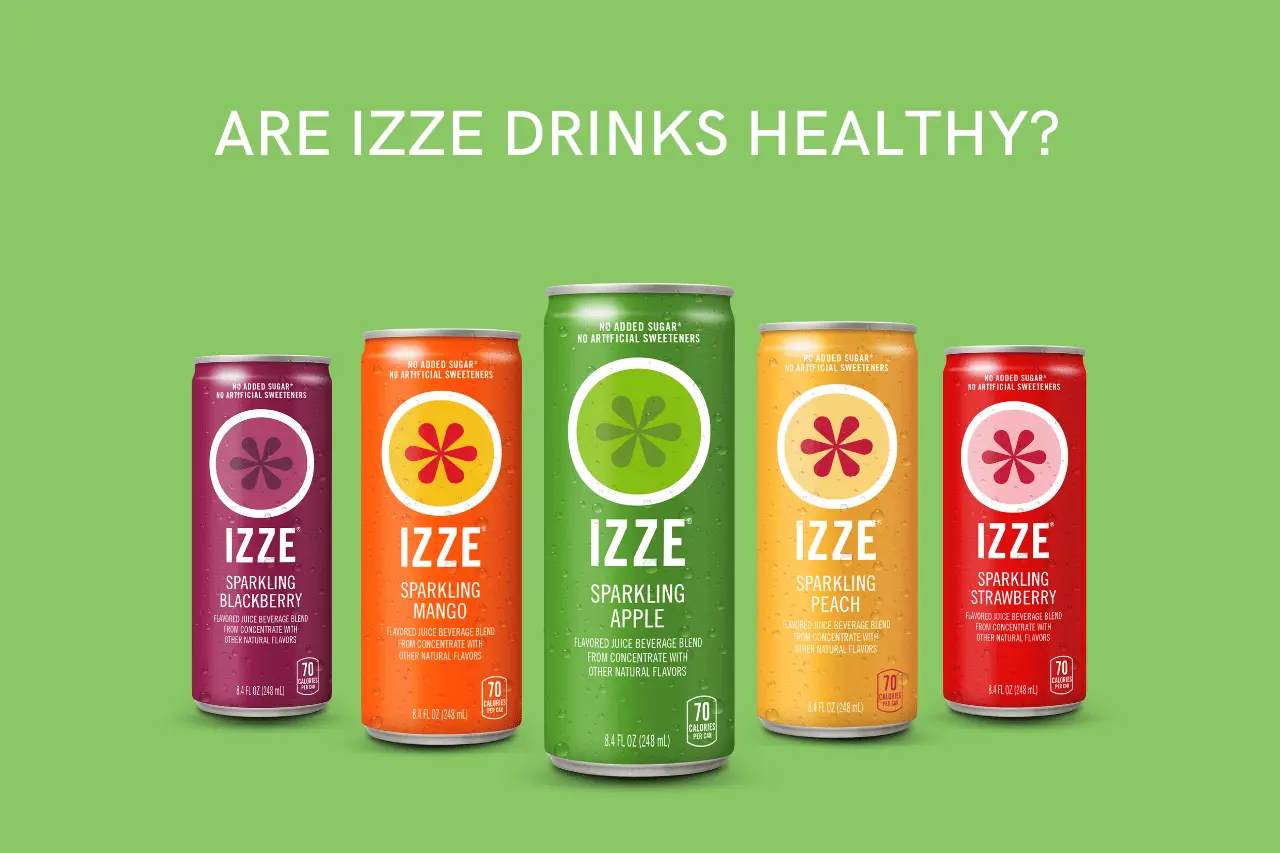
You’re standing in the beverage aisle, staring at rows of colorful cans. You’ve been trying to quit soda, but plain water feels… well, boring. Then you spot those sleek Izze bottles—sparkling, fruity, made with “real juice,” and no added sugar.
Could this be the answer? A guilt-free way to enjoy something fizzy without the health baggage of regular soda?
I get it. The struggle to find a drink that’s both refreshing and actually good for you is real. Izze has positioned itself perfectly in that sweet spot—not quite soda, not quite juice, but somewhere deliciously in between.
But here’s the question everyone’s asking: Are Izze drinks actually healthy, or is this just clever marketing?
The answer is more nuanced than you’d think. While Izze drinks are definitely better than Coke or Pepsi, they’re not the health heroes they appear to be. They’ve got some genuine upsides, but also some concerns worth knowing about before you stock your fridge.
Let me break down everything you need to know about Izze drinks—the good, the not-so-good, and whether they deserve a spot in your healthy lifestyle.
Read also: Is Jumex Healthy? The Truth About This Fruit Nectar
What Exactly Are Izze Drinks?
Izze burst onto the scene in 2002 when founders Greg Stroh and Todd Woloson had a simple but brilliant idea in Boulder, Colorado: create a sparkling beverage that combined real fruit juice with carbonated water—no added sugar, no artificial anything.
The concept resonated with health-conscious consumers who were tired of choosing between boring water and sugar-loaded sodas. PepsiCo noticed this growing trend and acquired the brand, helping Izze expand nationwide.
What makes Izze different:
- Made with 70% sparkling water and 30% fruit juice (some flavors vary)
- No added sugars or artificial sweeteners
- No artificial colors, flavors, or preservatives
- Non-GMO, gluten-free, and vegan
- Comes in nostalgic glass bottles (though cans are available too)
Popular Izze flavors:
- Sparkling Clementine
- Sparkling Blackberry
- Sparkling Apple
- Sparkling Grapefruit
- Sparkling Peach
- Sparkling Pomegranate
- Sparkling Mango
- Cherry Lime
The variety is impressive, and honestly, they taste pretty good. But taste doesn’t automatically equal healthy. Let’s dig deeper.
Breaking Down Izze Ingredients: What’s Really Inside?
One thing I appreciate about Izze is their transparent ingredient list. You won’t find a bunch of unpronounceable chemicals here.
Main ingredients in most Izze drinks:
- Carbonated water (the base)
- Fruit juice from concentrate (varies by flavor—apple, grape, lime, etc.)
- Natural flavors
- Citric acid (for tartness and preservation)
- Gum arabic (a natural stabilizer from acacia trees)
- Beta carotene (natural coloring from plants)
What’s NOT in Izze drinks:
✅ No added sugars
✅ No high fructose corn syrup
✅ No artificial sweeteners (aspartame, sucralose, etc.)
✅ No artificial colors or dyes
✅ No preservatives like sodium benzoate
✅ No caffeine
From an ingredient standpoint, Izze is legitimately clean. This isn’t greenwashing—they’ve kept their promise of using real, recognizable ingredients.
The Fruit Juice Concentrate Question
Here’s where things get a bit murky. Izze claims their drinks contain “60% fruit juice” on some bottles, but carbonated water is listed as the first ingredient (meaning there’s more water than juice).
This seems contradictory, right? Here’s what’s happening: the percentage refers to the juice portion before dilution. Once they add sparkling water, the actual juice content in your bottle is lower—probably closer to 30-40%.
Also, let’s talk about “from concentrate.” This means they take real fruit, extract all the juice, remove the water to create a thick syrup, ship it cheaply, then add water back later.
What gets lost in this process:
- Heat-sensitive vitamins (especially vitamin C)
- Natural fiber from the fruit
- Some of the fresh fruit flavor and aroma compounds
- Beneficial enzymes
So while Izze uses real fruit juice, it’s not the same as blending fresh fruit at home. The nutrition takes a hit during processing.
The Sugar Situation: Let’s Talk Numbers
This is where Izze’s health halo starts to crack a little.
Sugar content per 8.4 oz bottle:
- 14-15g of natural sugar (depending on flavor)
- Zero added sugar (this is true!)
- No artificial sweeteners
“But wait,” you’re thinking, “natural sugar is better than added sugar, right?”
Well… kind of. Here’s the complicated truth: once sugar hits your bloodstream, your body doesn’t really distinguish between “natural” and “added” sugar. Both affect your blood glucose levels similarly.
Putting 14-15g in perspective:
- The American Heart Association recommends max 25g added sugar/day for women
- That’s max 36g/day for men
- One Izze bottle gives you 56-60% of a woman’s daily limit
- That’s 39-42% of a man’s daily limit
Now, technically this is “natural” sugar from fruit, so it doesn’t count toward the added sugar recommendation. But consuming too much of any sugar—natural or not—can still contribute to weight gain, blood sugar issues, and other health concerns.
Here’s the kicker: When you eat a whole apple, you get about 19g of natural sugar, but you also get 4g of fiber that slows down sugar absorption. With Izze, you get the sugar without the fiber buffer. Your blood sugar rises faster, and you don’t feel as full.
Nutritional Reality Check: What Else Does Izze Offer?
Let’s be honest about the nutritional value here.
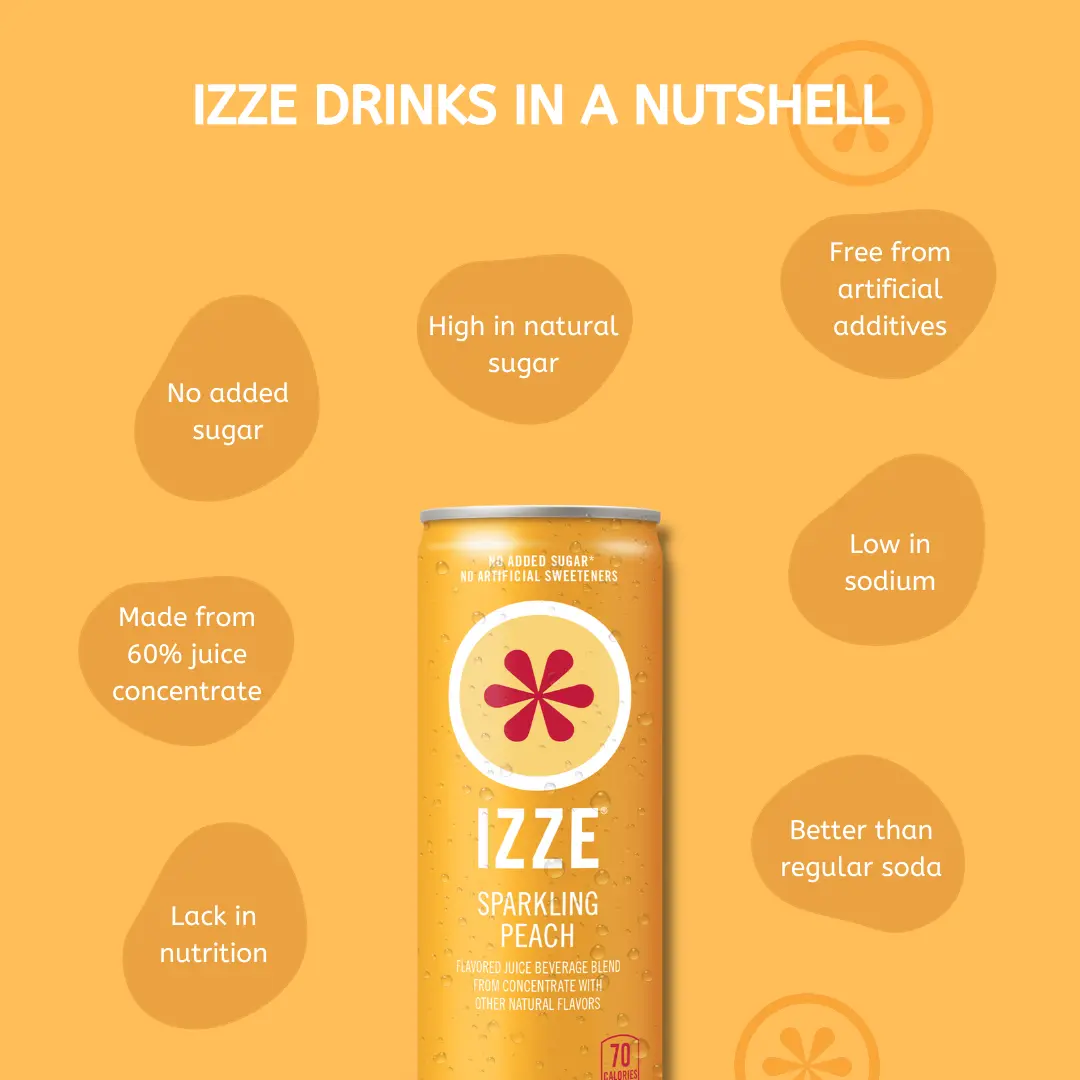
Per 8.4 oz bottle:
- Calories: 70
- Carbohydrates: 18g
- Sugar: 14-15g
- Protein: 0g
- Fiber: 0g
- Fat: 0g
- Sodium: 10mg
- Vitamins & minerals: Minimal to none
You’re basically getting calories from sugar, and that’s it. No protein to keep you satisfied. No fiber for gut health. No significant vitamins or minerals.
Compare this to eating actual fruit: an orange gives you vitamin C, fiber, folate, and potassium. A handful of blackberries provides antioxidants, fiber, and vitamin K.
Izze gives you the sweetness of fruit without most of the nutritional benefits. It’s a step up from soda, but it’s not a nutritional powerhouse by any stretch.
Are Izze Drinks Really Better Than Soda? The Honest Comparison
This is the comparison everyone wants to see. Let’s break it down honestly.
Where Izze wins over regular soda:
✅ Real fruit juice vs. zero fruit content – At least there’s some actual fruit in there
✅ No added sugar vs. 39g added sugar – Huge difference here
✅ No HFCS vs. loaded with HFCS – Izze avoids this controversial sweetener
✅ Natural ingredients vs. artificial everything – Cleaner ingredient list overall
✅ 14-15g sugar vs. 39g sugar – Significantly less sugar per serving
Similarities between Izze and soda:
≈ Both are carbonated beverages
≈ Both contain calories from sugar
≈ Neither provides significant nutrition
≈ Both can contribute to sugar overconsumption if you drink too much
≈ Both can satisfy that fizzy craving
The verdict?
Izze is undeniably healthier than Coca-Cola, Pepsi, or Sprite. It’s not even close. If you’re transitioning away from soda and need something to ease the process, Izze is a reasonable bridge option.
But—and this is important—Izze isn’t “healthy” in the way vegetables or fruit are healthy. It’s “healthier than soda,” which is a pretty low bar.
Think of it this way: choosing Izze over Coke is like choosing a small slice of cake instead of a giant slice. You’re making a better choice, but you’re still eating cake.
How Does Izze Stack Up Against Other “Better-For-You” Drinks?
The sparkling beverage market has exploded recently, with tons of brands competing for health-conscious consumers. Let’s see how Izze compares to its main competitors.
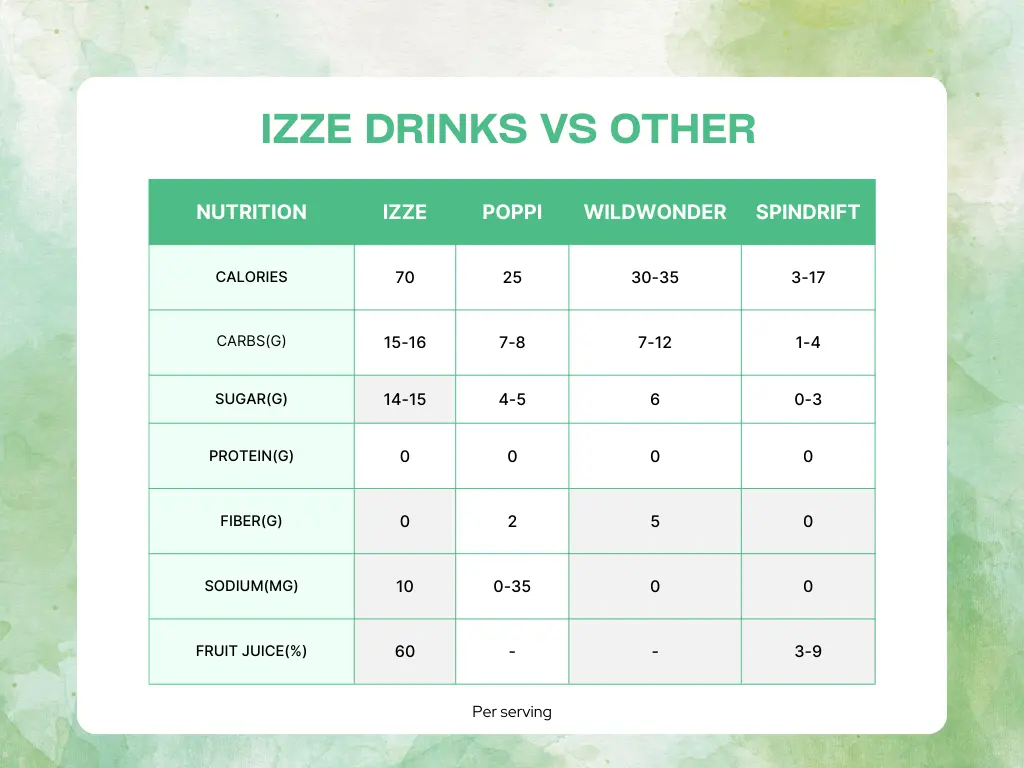
Izze vs. Poppi (Prebiotic Soda)
Poppi has been all over social media lately, marketed as a gut-health soda with prebiotics.
Poppi’s advantages:
- Lower sugar: 4-5g per can (uses organic cane sugar + stevia)
- Contains prebiotics: 2g of apple cider vinegar fiber for gut health
- Lower calories: 25 per can
- Functional benefit beyond just taste
Where Izze wins:
- More fruit juice content (tastes more like real fruit)
- No artificial sweeteners (Poppi uses stevia, which some people dislike)
- No apple cider vinegar taste (Poppi has a slight tang)
Bottom line: Poppi is objectively healthier if you’re counting sugar and calories. But if you hate stevia or want a more authentic fruit taste, Izze might be your preference. Personally, I’d choose Poppi for daily drinking and Izze as an occasional treat.
Izze vs. Olipop (Digestive Health Soda)
Olipop is another prebiotic soda that’s gained a cult following.
Olipop’s advantages:
- Much lower sugar: 2-5g per can
- Contains 9g of fiber (from chicory root, Jerusalem artichoke, etc.)
- Includes prebiotics, probiotics, and botanicals
- Truly functional beverage with digestive benefits
Where Izze wins:
- Simpler ingredient list (some people find Olipop too “engineered”)
- More straightforward fruit flavor
- No stevia aftertaste
Bottom line: Olipop is the clear winner for health benefits, especially gut health. But it’s pricier and has a more acquired taste. If you want functional benefits, go Olipop. If you just want fizzy fruit flavor, Izze works fine.
Izze vs. Spindrift (Real Squeezed Fruit)
Spindrift has gained popularity for using actual squeezed fruit instead of concentrates.
Spindrift’s advantages:
- Much lower sugar: 0-4g per can (depending on flavor)
- Uses real squeezed fruit, not concentrate
- Lower calories: 3-17 per can
- More subtle, refreshing flavor (not as sweet)
Where Izze wins:
- More fruit juice content (70% vs. Spindrift’s hint of fruit)
- Sweeter taste (if you want that)
- More satisfying as a soda replacement
Bottom line: Spindrift is definitely the healthier choice—it’s basically flavored sparkling water with a tiny amount of real fruit. But it’s not as sweet or filling as Izze. Choose Spindrift if you’ve already weaned yourself off sweet drinks. Choose Izze if you’re still transitioning from soda and need more flavor.
Izze vs. Wildwonder (Probiotic Sparkling Drink)
Wildwonder is a newer player focusing on gut health with live probiotics.
Wildwonder’s advantages:
- Lower sugar: 6g per can
- Contains live probiotics for gut health
- High fiber: 5g per serving
- Uses organic ingredients and functional herbs
Where Izze wins:
- More accessible flavor (less herbal/botanical)
- Wider availability in stores
- Simpler taste profile
Bottom line: Wildwonder is significantly healthier if you’re focused on gut health and fiber. But the herbal notes aren’t for everyone. Try both and see what you prefer.
The Sparkling Water Hierarchy
If I had to rank these drinks from healthiest to least healthy:
- Spindrift (basically sparkling water with fruit essence)
- Olipop (functional benefits, low sugar, high fiber)
- Poppi (prebiotics, low sugar, good taste)
- Wildwonder (probiotics, decent sugar, high fiber)
- Izze (real ingredients but high natural sugar)
- Regular soda (disaster for your health)
Notice where Izze lands—better than soda, but not the healthiest option in the better-for-you beverage category.
Is Izze Good for Weight Loss? The Uncomfortable Truth
If you’re trying to lose weight, Izze isn’t your best friend—but it’s not your worst enemy either.
Why Izze isn’t ideal for weight loss:
❌ 70 calories from pure sugar – These are “empty calories” with no nutritional value
❌ No protein or fiber – Won’t keep you full or satisfied
❌ Liquid calories don’t register like solid food – Your brain doesn’t recognize them as “eating”
❌ Can trigger sugar cravings – Even natural sugar can make you want more sweet stuff
❌ Easy to overconsume – One bottle leads to another before you know it
Here’s the math: If you drink one Izze daily instead of water, that’s 490 extra calories per week, or 25,480 calories per year. That translates to roughly 7 pounds of potential weight gain annually—just from one daily drink.
However, Izze isn’t terrible for weight loss either:
✅ Much better than regular soda (saves ~100 calories per serving)
✅ Might satisfy sweet cravings without reaching for candy
✅ Could help you transition away from higher-calorie drinks
✅ Only 70 calories, which you can account for in your daily intake
The smart approach: If you’re serious about weight loss, treat Izze as an occasional indulgence (1-2 times per week max), not a daily beverage. Your go-to drinks should be water, unsweetened tea, black coffee, or true zero-calorie sparkling waters like La Croix or Waterloo.
Similar to drinks like Jumex or Simply Lemonade, Izze falls into that tricky category of “better but not great” for weight management.
Who Should (and Shouldn’t) Drink Izze?
Let me give you some real-world scenarios to help you decide if Izze fits your lifestyle.
Izze might be a good choice if you:
✅ Are actively quitting soda – It’s a solid stepping stone
✅ Want an occasional treat – Works great for special occasions
✅ Need a cocktail mixer – Better than sugary mixers for mocktails
✅ Prefer natural ingredients – Clean label with recognizable items
✅ Don’t have diabetes or blood sugar issues – Can handle the sugar impact
✅ Exercise regularly – The 70 calories won’t derail your fitness
Skip Izze (or be very cautious) if you:
❌ Have diabetes or pre-diabetes – The sugar will spike your glucose
❌ Struggle with sugar addiction – Natural sugar can still be triggering
❌ Are actively losing weight – Better options exist
❌ Drink multiple bottles daily – Sugar intake adds up fast
❌ Have IBS or digestive issues – Carbonation can cause bloating
❌ Are on a strict low-sugar diet – 14-15g is still significant
Does Izze Have Caffeine? And Other Quick Questions
Does Izze contain caffeine?
Nope! All Izze flavors are completely caffeine-free. Great news if you’re sensitive to caffeine or drinking them in the evening.
Is Izze gluten-free?
Yes, Izze is gluten-free. None of the ingredients contain gluten, making it safe for people with celiac disease or gluten sensitivity.
Is Izze vegan?
Yes! Izze doesn’t use any animal-derived ingredients. No milk, honey, gelatin, or other animal products. The beta carotene coloring is plant-based.
Are Izze bottles recyclable?
Yes, both the glass bottles and aluminum cans are recyclable. The glass bottles are particularly nice for reusing if you’re into that.
Can kids drink Izze?
Technically yes, but I wouldn’t make it a regular thing. The sugar content is still pretty high for small bodies. Water and milk should be their main drinks. Save Izze for occasional treats or celebrations.
The Final Verdict: Are Izze Drinks Healthy?
Alright, let’s bring this home with some real talk.
Are Izze drinks healthy?
The honest answer: They’re healthier than soda, but they’re not exactly healthy.
Think of Izze as the middle ground between regular soda and truly healthy beverages. They deserve credit for:
✅ Using real fruit juice instead of artificial flavors
✅ Avoiding added sugars and HFCS
✅ Skipping artificial sweeteners, colors, and preservatives
✅ Being non-GMO, gluten-free, and vegan
✅ Offering a way to transition away from worse drinks
But let’s not pretend they’re a health food. The reality:
❌ High in natural sugar (14-15g per bottle)
❌ Provides minimal nutrition despite being fruit-based
❌ Made from concentrate, not fresh fruit
❌ Contains zero fiber to slow sugar absorption
❌ Contributes empty calories that can hinder weight loss
My personal recommendation: Enjoy Izze as an occasional treat—maybe 1-3 times per week max. It’s a perfectly fine choice when you want something fizzy and fruity without the guilt of drinking Coke.
But for everyday hydration? Stick with water, unsweetened tea, or lower-sugar options like Spindrift or Bai drinks.
Izze occupies that interesting space of being good enough to not feel terrible about, but not good enough to drink freely without thought. Use it wisely, enjoy the flavors you love, and balance it with genuinely hydrating, nutritious beverages the rest of the time.
Your body deserves better than constant sugar, even when it’s “natural” sugar. But it also deserves occasional enjoyment. Izze can absolutely fit into a healthy lifestyle—just keep it in its proper place as an occasional indulgence, not a daily staple.
What’s your take on Izze? Have you found better alternatives? Share your thoughts in the comments below!
Here are a few other posts that might also be helpful for you.