
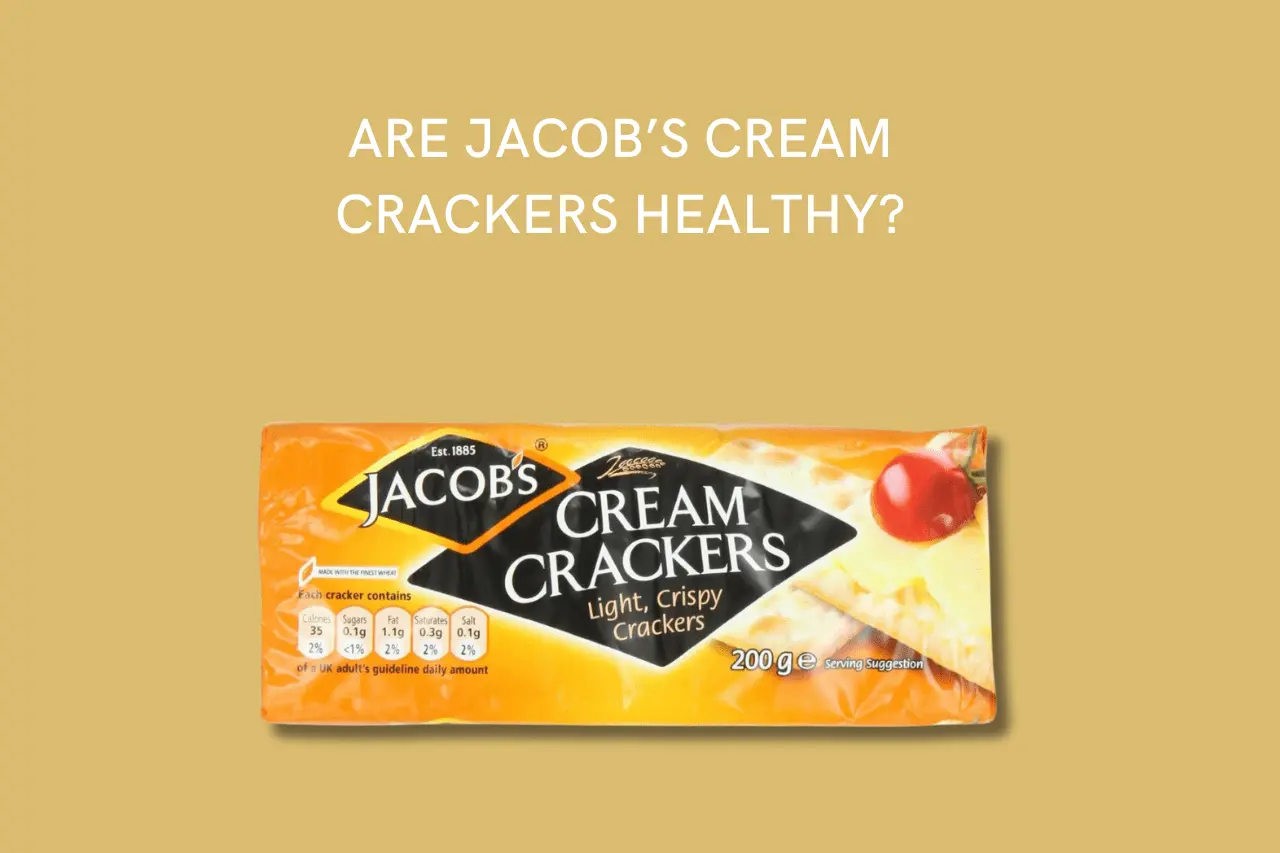
You’re at your parents’ house for tea, and there they are on the table – those familiar yellow boxes of Jacob’s cream crackers.
The same crackers you’ve been eating since you were a kid. The ones your nan always had with cheese. The ones that make that perfect crunch when you bite down.
Pure nostalgia in cracker form.
But now you’re trying to eat healthier, and you’re wondering: are these actually any good for you? Or have you been mindlessly munching on processed junk disguised as a wholesome British classic?
Here’s the truth about Jacob’s cream crackers that the cozy packaging doesn’t advertise.
The Verdict: Not Great, But Not Terrible Either
Jacob’s cream crackers are not particularly healthy because they’re made with refined wheat flour (not whole grain), contain palm oil, and deliver minimal protein and fiber.
However, they’re extremely low in sugar, free from artificial additives, and only 35 calories per cracker. They’re not a nutritional powerhouse, but they’re not the villain in your diet either.
Think of them as neutral territory – not actively helping your health, but not destroying it if you keep portions reasonable.
The real question isn’t whether the crackers themselves are healthy. It’s what you’re piling on top of them. But we’ll get to that.
What Are Jacob’s Cream Crackers Actually Made Of?
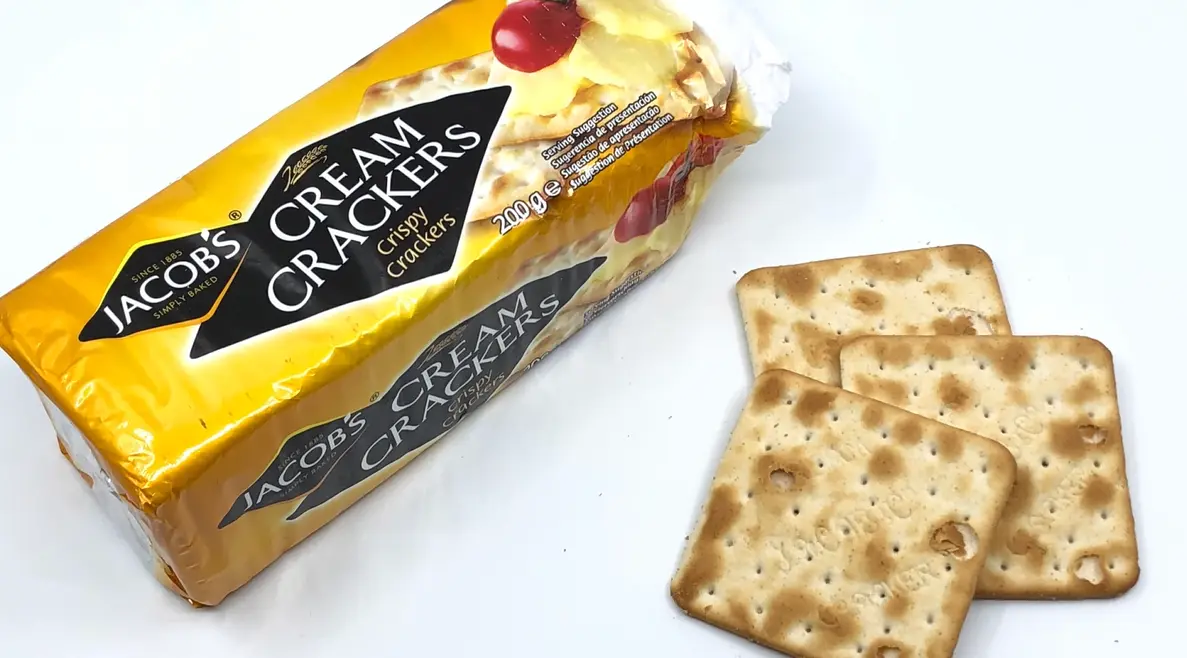
Let’s start with the obvious question nobody seems to ask: why are they called “cream” crackers when there’s no cream in them?
The “cream” refers to the creaming method used during baking – mixing fat into flour to create that light, flaky texture. It’s a baking technique, not an ingredient. No dairy involved.
Mystery solved.
Now, what’s actually inside these British icons?
Main ingredients:
- Wheat flour (enriched with calcium, iron, and niacin)
- Palm oil
- Salt
- Raising agent (sodium bicarbonate)
- Yeast
That’s it. Refreshingly short ingredient list, especially compared to most processed snacks.
The good news: No artificial flavors, colors, or preservatives. Just real ingredients.
The bad news: That wheat flour isn’t whole grain.
Notice it doesn’t say “whole wheat flour” or “whole grain flour.” Just “wheat flour.” That means the bran and germ – the most nutritious parts of the grain – have been stripped away during processing.
Then they “enrich” it by adding back synthetic vitamins and minerals to replace what was lost. It’s like demolishing a house and then slapping a fresh coat of paint on the rubble and calling it renovated.
Enriched flour isn’t evil, but it’s not as nutritious as whole grain flour. You’re missing out on natural fiber, B vitamins, and antioxidants.
The Palm Oil Problem
Then there’s the palm oil.
Palm oil itself isn’t necessarily unhealthy from a nutritional standpoint – it’s just a fat. But it’s controversial for environmental and ethical reasons (deforestation, habitat destruction, etc.).
From a pure health perspective, palm oil is high in saturated fat. Not the end of the world in small amounts, but not ideal compared to healthier fats like olive oil or rapeseed oil.
If you’re environmentally conscious or trying to limit saturated fat, the palm oil is a strike against Jacob’s cream crackers.
The Nutrition Reality Check
Let’s break down what you’re actually eating when you grab a few of these crackers.
Sugar: Actually Impressive
Jacob’s cream crackers contain less than 0.1g of sugar per cracker (8g serving).
That’s practically sugar-free.
In a world where even “savory” snacks are loaded with hidden sugars, this is genuinely refreshing. If you’re trying to cut sugar or avoid blood sugar spikes, Jacob’s cream crackers won’t sabotage you.
| Serving | Sugar |
|---|---|
| Per cracker (8g) | <0.1g |
| Per 100g | 0.6g |
Protein: Disappointingly Low
Each cracker contains 0.8g of protein.
To get a decent protein hit (say, 5-6g), you’d need to eat 6-7 crackers. And by that point, you’re racking up calories and sodium without much nutritional payoff.
Protein is crucial for satiety – it’s what keeps you full between meals. Without it, you’ll be back in the kitchen hunting for snacks within an hour.
| Serving | Protein |
|---|---|
| Per cracker (8g) | 0.8g |
| Per 100g | 10g |
Fiber: Even Worse
With less than 0.2g of fiber per cracker, Jacob’s cream crackers are basically a fiber desert.
You’d need to eat an entire pack to get 4-5g of fiber – and that’s still not even 20% of your daily needs.
Fiber is what slows down digestion, regulates blood sugar, and keeps your digestive system happy. Without it, these crackers will digest quickly and leave you unsatisfied.
This is the downside of using refined flour instead of whole grain. Whole grain crackers would deliver 2-3 times more fiber.
| Serving | Fiber |
|---|---|
| Per cracker (8g) | 0.2g |
| Per 100g | 3g |
Sodium: Fine in Small Doses, Adds Up Fast
Each cracker contains 100mg of sodium – about 6% of the American Heart Association’s daily recommended limit (1,500mg).
One or two crackers? No problem.
But let’s be honest: who stops at two crackers? You’re having them with cheese, maybe some pickle, and suddenly you’ve eaten six crackers without thinking. That’s 600mg of sodium – 40% of your daily limit – before you even count what’s on top.
If you’re watching your salt intake (and most people should), portion control becomes critical.
| Serving | Sodium |
|---|---|
| Per cracker (8g) | 100mg |
| Per 100g | 1,300mg |
Calories: Reasonable Per Cracker
At 35 calories per cracker, these aren’t calorie bombs.
The problem? They’re not filling either. Low protein, low fiber, refined carbs – this is a recipe for eating way more than you intended.
Three crackers feel like nothing, but that’s already 105 calories. Add cheese and butter, and you’re easily hitting 200-300 calories for what feels like a light snack.
The Topping Reality: This Changes Everything
Here’s the thing nobody talks about: Jacob’s cream crackers are never eaten alone.
They’re a vehicle. A platform. A delivery system for what you actually want to eat.
And those toppings completely change the nutritional equation.
Slather them with butter? You’ve just added saturated fat and calories.
Pile on cheddar cheese? More saturated fat, more sodium, but at least you’re getting protein and calcium.
Spread hummus? Now you’ve added plant protein, fiber, and healthy fats – suddenly this snack makes more sense.
Top with smoked salmon and cream cheese? Protein, omega-3s, and yes, more fat and sodium.
The crackers themselves are just the foundation. What you build on top determines whether this is a reasonably healthy snack or a sodium-and-fat festival.
If you’re going to eat Jacob’s cream crackers, make your toppings count. Skip the butter. Choose protein-rich options like cottage cheese, nut butter, tinned fish, or hummus.
How Do They Compare to Other British Crackers?
Let’s see how Jacob’s cream crackers stack up against other UK staples.
vs Digestive Biscuits:
Digestives have more sugar (up to 5g per biscuit) but also more fiber because they’re made with whole wheat flour. If you want fiber, choose digestives. If you want low sugar, stick with Jacob’s.
vs Ryvita:
Ryvita crispbreads are whole grain, higher in fiber (1-2g per slice), and lower in sodium. Nutritionally superior to Jacob’s, but the texture is drier and less satisfying for many people.
vs Oatcakes:
Oatcakes deliver more fiber and whole grains, but also more calories and sometimes more fat. They’re heartier and more filling, but less versatile for toppings.
vs Water Crackers:
Similar nutritional profile to Jacob’s – refined flour, low protein, low fiber. Basically the same category of “neutral base cracker.”
Bottom line: If you want the most nutritious cracker, go for whole grain options like Ryvita or oatcakes. But if you want something light, crispy, and nostalgic, Jacob’s cream crackers are fine in moderation.
Are Jacob’s Cream Crackers Good for Weight Loss?
Here’s where it gets tricky.
On paper, Jacob’s cream crackers seem weight-loss friendly:
- Only 35 calories per cracker
- Practically zero sugar
- Low fat per serving
But in reality, they’re not ideal for weight loss because:
- Low protein and fiber means they won’t keep you full
- Easy to overeat without realizing it (that whole “just one more” trap)
- Usually topped with high-calorie ingredients that add up fast
If you’re trying to lose weight, these crackers won’t ruin your diet, but they won’t help either. They’re just empty vehicles for whatever you’re actually craving.
A better weight-loss snack would be something with protein and fiber that actually satisfies you – Greek yogurt, a handful of nuts, veggie sticks with hummus.
But if you genuinely love Jacob’s cream crackers and can control your portions (2-3 crackers max with a protein-rich topping), they can fit into a weight-loss plan.
Just don’t lie to yourself about how many you’re eating.
Are Jacob’s Cream Crackers Vegan and Gluten-Free?
Vegan: Yes. No dairy, eggs, or animal products. Despite the name, there’s no cream.
Gluten-free: Absolutely not. They’re made with wheat flour, so they’re packed with gluten.
If you’re celiac or gluten-intolerant, stay far away. If you’re vegan, you’re good to go.
When Jacob’s Cream Crackers Make Sense (And When They Don’t)
Eat Jacob’s cream crackers when:
- You want something low in sugar for a savory snack
- You’re topping them with protein-rich foods (cheese, hummus, nut butter)
- You can genuinely limit yourself to 2-3 crackers
- You’re at a family gathering and they’re part of the tradition (nostalgia has value!)
- You prefer them to higher-sugar alternatives like digestives
Skip Jacob’s cream crackers when:
- You’re looking for a filling, satisfying snack (low protein and fiber won’t cut it)
- You’re trying to increase whole grain intake
- You want to avoid palm oil for environmental reasons
- You know you’ll demolish half the box without thinking
- You need something to keep you full until your next meal
The Nostalgia vs Nutrition Balance
Here’s the truth nobody wants to hear: Jacob’s cream crackers aren’t a health food.
They’re made with refined flour. They contain palm oil. They’re nutritionally mediocre.
But they’re also not junk food.
No artificial ingredients. Minimal sugar. Reasonable calories. They’re just… fine.
And sometimes, fine is good enough.
If Jacob’s cream crackers are tied to happy memories – tea at your grandparents’ house, after-school snacks, cheese and crackers at Christmas – that emotional value matters too.
You don’t have to optimize every single food choice. Life is long, and completely eliminating foods you love for marginal health benefits is miserable.
My advice? Keep Jacob’s cream crackers in rotation if you genuinely enjoy them. Just don’t convince yourself they’re healthy. Be honest about portions. Choose nutritious toppings. Balance them out with actual whole grains elsewhere in your diet.
And if you want to upgrade nutritionally, try whole grain crackers like Ryvita or oatcakes a few times a week instead.
You can have nostalgia and nutrition. You just can’t pretend they’re the same thing.
Found this helpful? Check out these related articles: