
It’s 9 PM. You’re settling in for movie night, and that familiar craving hits—you need something crunchy, salty, and satisfying. You reach for the pantry, and there’s that eye-catching bag of Popcorners staring back at you.
They look promising. The bag says “never fried,” “gluten-free,” “no artificial anything.” They’re shaped like chips but made from popcorn, so they must be healthier than Doritos or Lays, right?
But before you tear open that bag and devour half of it (we’ve all been there), you pause: Are Popcorners actually healthy, or is this just clever marketing making you feel less guilty about snacking?
It’s a fair question. Popcorners have exploded in popularity over the past few years, positioning themselves as the “better-for-you” chip alternative. They’re in every grocery store, gym bag, and office vending machine. Health-conscious snackers swear by them.
But when you really dig into the nutrition facts and ingredients, are they living up to the hype?
The honest answer? Popcorners are definitely better than most chips, but they’re not perfect. They have some genuinely good qualities that set them apart, but also some concerns worth knowing about—especially that sodium content everyone seems to overlook.
In this honest review, I’ll break down everything you need to know about Popcorners—the good, the not-so-good, and whether they deserve their “healthy snack” reputation.
What Exactly Are Popcorners?
Popcorners launched in 2008 with a simple but clever idea: take popped corn and press it into chip-like triangular shapes. You get the satisfying crunch of chips with the lighter, airier feel of popcorn.
How they’re made: Instead of frying like traditional chips, Popcorners use an “air-popping” technique that combines heat and moisture under pressure. This pops the corn kernels and shapes them simultaneously, resulting in that distinctive crispy texture without needing a fryer full of oil.
What sets them apart from regular chips:
- Never fried (air-popped instead)
- Made with non-GMO corn
- No artificial flavors or colors
- Gluten-free (most flavors)
- Lower in fat and calories
Popular Popcorners flavors:
- Sea Salt (the classic)
- White Cheddar
- Sour Cream & Onion
- Sweet Chili
- Spicy Queso
- Kettle Corn (sweet)
- Cinnamon Crunch (dessert-like)
The variety is impressive, and honestly, they taste pretty good. But taste doesn’t automatically mean healthy. Let’s dig into what you’re actually eating.
Breaking Down the Nutrition: Flavor by Flavor
Here’s what you get per serving (1 oz, about 18-20 pieces):
| Flavor | Calories | Carbs | Fat | Protein | Fiber | Sodium |
|---|---|---|---|---|---|---|
| Sea Salt | 120 | 23g | 2.5g | 2g | 0g | 190mg |
| White Cheddar | 140 | 19g | 6g | 0g | 0g | 160mg |
| Sour Cream & Onion | 140 | 19g | 6g | 0g | 0g | 180mg |
| Sweet Chili | 130 | 21g | 4g | 2g | 0g | 200mg |
| Spicy Queso | 130 | 20g | 5g | 2g | 0g | 180mg |
| Kettle Corn | 130 | 22g | 4g | 0g | 0g | 110mg |
| Cinnamon Crunch | 130 | 21g | 4.5g | 2g | 0g | 100mg |
Quick Observations:
The good:
- 120-140 calories per serving (reasonable)
- 2.5-6g fat (much lower than regular chips)
- Some flavors offer 2g protein
The concerning:
- Sodium ranges from 110-200mg (we need to talk about this)
- Zero fiber in all flavors (disappointing for a corn-based snack)
- Protein is minimal or non-existent
Now let’s break down the ingredients and see what’s really in that crunchy triangle.
What’s Inside: Popcorners Ingredients
The ingredient list is refreshingly simple compared to most chips.
Main ingredients across all flavors:
- Yellow corn (non-GMO)
- Sunflower or canola oil (not fried, just used for flavor)
- Sea salt or regular salt
Additional flavor-specific ingredients:
- Whey and milk (for cheese flavors)
- Onion powder, garlic powder (savory flavors)
- Paprika extract, annatto extract (natural coloring)
- Buttermilk (creamy flavors)
- Black pepper, red pepper (spicy varieties)
- Maltodextrin (found in some flavors—more on this later)
- Natural flavors (the vague but supposedly natural stuff)
- Citric acid and lactic acid (natural preservatives)
What’s NOT in Popcorners:
✅ No artificial colors or flavors
✅ No MSG
✅ No high fructose corn syrup
✅ No trans fats
✅ No cholesterol
✅ No synthetic preservatives
From an ingredient standpoint, Popcorners are legitimately clean. This isn’t greenwashing—they’ve kept their promise of using real, recognizable ingredients.
5 Reasons Popcorners Are Better Than Regular Chips
Let’s give credit where it’s due. Popcorners have some genuine advantages over traditional chips.
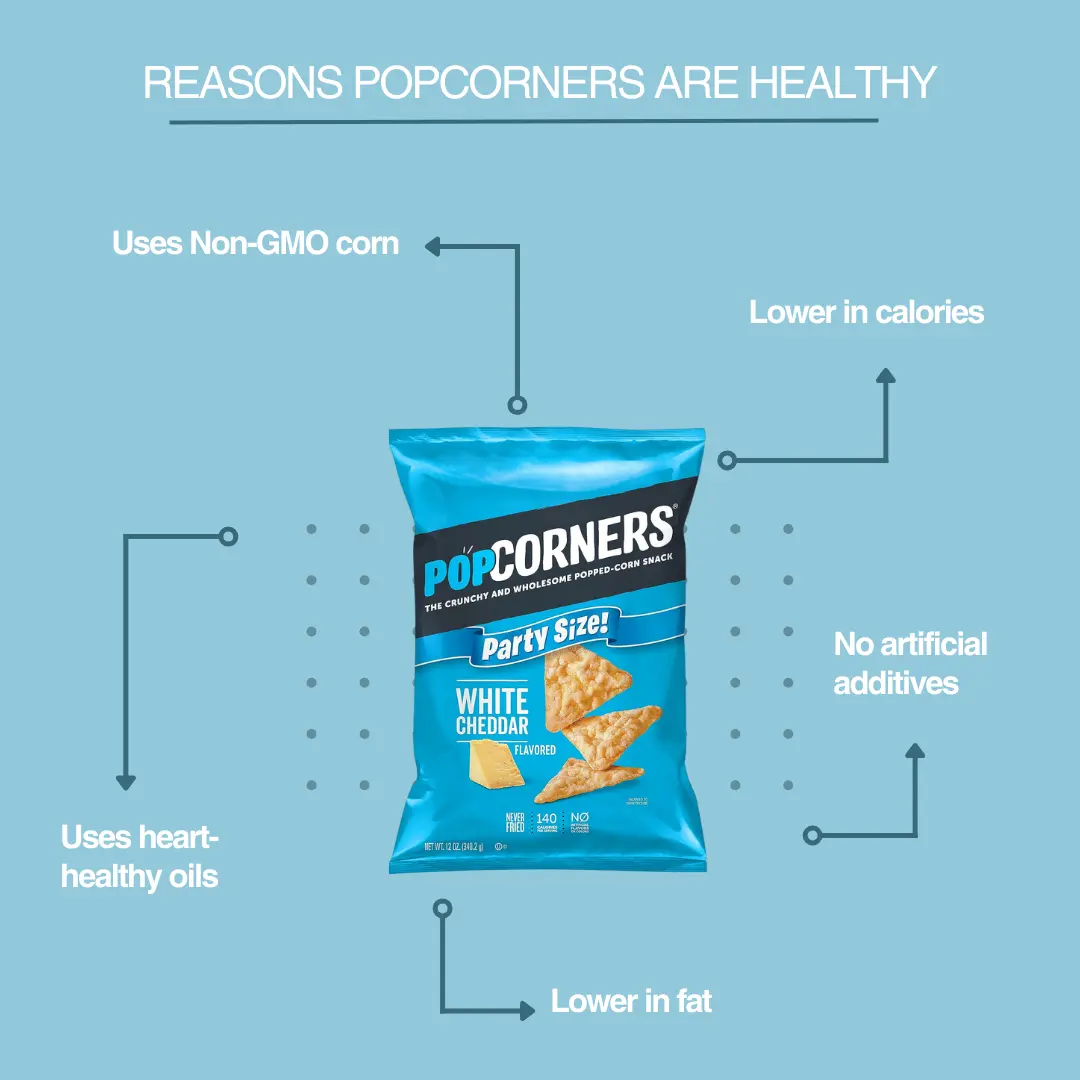
1. Non-GMO Corn Makes a Real Difference
All Popcorners are made from non-GMO corn sourced from family farms. This means no genetically modified organisms, no questionable pesticides, and no potential health risks associated with GMO crops.
While the scientific jury is still out on long-term GMO effects, some studies suggest potential concerns with liver, kidney, and reproductive health. By choosing non-GMO, Popcorners eliminate these uncertainties.
Plus, supporting family farmers instead of industrial agriculture is an ethical bonus.
2. Significantly Lower in Calories
Here’s where Popcorners shine compared to traditional chips:
Calorie comparison per 1 oz serving:
- Popcorners: 120-140 calories
- Doritos: 150 calories
- Lays Classic: 160 calories
- Cheetos: 160 calories
- Pringles: 150 calories
That 20-40 calorie difference per serving adds up. If you snack on chips three times a week, choosing Popcorners could save you over 3,000 calories per year—that’s nearly a pound of body fat you won’t gain.
For weight-conscious snackers, this is a legitimate advantage. Check out our comparison with Doritos to see just how much better Popcorners are.
3. Healthier Oils (And Less of Them)
Most chips swim in cheap, inflammatory oils like palmolein or corn oil. Popcorners use sunflower or canola oil—both lower in saturated fat and better for heart health.
Why this matters:
- Sunflower oil is high in vitamin E (antioxidant)
- Canola oil has omega-3 fatty acids (anti-inflammatory)
- Both are low in saturated fat (better for cholesterol)
“But isn’t sunflower oil inflammatory?” I hear you asking. Yes, when consumed in large quantities. But here’s the key: Popcorners are air-popped, not deep-fried. The amount of oil used is minimal—just enough for flavor and texture.
Compare this to Lays or Doritos that are literally soaked in oil during frying. Not even close.
4. Much Lower in Fat (And It’s Mostly Good Fat)
With only 2.5-6g of fat per serving, Popcorners are one of the lowest-fat chips available.
Fat comparison:
- Popcorners (Sea Salt): 2.5g fat
- Popcorners (White Cheddar): 6g fat
- Regular potato chips: 10g fat
- Doritos: 8g fat
- Cheetos: 10g fat
Even better, over 90% of the fat in Popcorners is unsaturated (the “good” kind that supports heart health). The Sea Salt flavor has only good fat—zero saturated fat.
For people managing cholesterol or trying to reduce overall fat intake, Popcorners are a smarter choice.
5. No Artificial Junk
Walk down the chip aisle and read the ingredient lists. You’ll see a parade of artificial colors (Red 40, Yellow 5), artificial flavors, MSG, weird preservatives, and stabilizers you can’t pronounce.
Popcorners skip all of that. They use real ingredients for flavor: onion powder, garlic powder, paprika extract, yeast extract. What you see is what you get.
The only “preservatives” are citric acid and lactic acid—both completely natural acids found in fruits and fermented foods. They’re safe and necessary for keeping the product fresh.
The Not-So-Good: What Popcorners Gets Wrong
Now for the uncomfortable truths that the marketing doesn’t emphasize.
1. The Sodium Situation No One Talks About
Here’s the elephant in the room: Popcorners contain 160-200mg of sodium per serving.
“That doesn’t sound like much,” you might think. But context matters.
Sodium perspective:
- Recommended daily limit: 1,500-2,300mg (depending on who you ask)
- One serving of Popcorners: 160-200mg (7-13% of daily limit)
- The problem: Who actually stops at one serving?
Be honest—when you open a bag of Popcorners, do you carefully measure out 1 oz and reseal it? Or do you mindlessly munch while watching TV and suddenly realize half the bag is gone?
If you eat 3 servings (which is easy to do), you’re looking at 480-600mg of sodium. That’s significant, especially if you’re watching your blood pressure or eating other salty foods throughout the day.
Sweet Chili has 200mg per serving—that’s the highest. If sodium is a concern, stick with Kettle Corn or Cinnamon Crunch (100-110mg).
2. Zero Fiber Is a Major Letdown
This genuinely surprises me. Popcorners are made from corn—a whole grain that naturally contains fiber. Yet somehow, they have ZERO fiber.
Why this matters:
- Fiber keeps you full and satisfied
- Fiber stabilizes blood sugar
- Fiber supports gut health and digestion
- Without fiber, you’ll keep eating and eating
The lack of fiber makes Popcorners less filling than they should be. You can easily eat multiple servings without feeling satisfied, which defeats the purpose of choosing a “healthier” snack.
3. Maltodextrin in Some Flavors
Sweet Chili and White Cheddar contain maltodextrin—a highly processed carbohydrate with a glycemic index even higher than table sugar (106-136 vs. 65).
Why this is concerning:
- Spikes blood sugar rapidly
- Not good for diabetics or pre-diabetics
- Can disrupt gut bacteria balance
- Adds “empty” carbs without nutrition
If you have diabetes or insulin resistance, avoid these flavors. Stick with Sea Salt or Kettle Corn instead.
4. Minimal Protein Means Zero Satiety
Most flavors have 0-2g of protein. That’s essentially nothing.
Protein is what keeps you full between meals and prevents blood sugar crashes. Without it, Popcorners become a pure carb bomb that’ll leave you hungry 30 minutes later.
Compare this to protein-based snacks (nuts, jerky, Greek yogurt) that actually satisfy hunger. Popcorners are fun to eat, but they won’t tide you over until your next meal.
Are Popcorners Good for Weight Loss?
This is where things get nuanced.
The case FOR Popcorners on a diet:
✅ Lower calories than regular chips (120-140 vs 150-160)
✅ Lower fat content (portion control friendly)
✅ Can satisfy crunchy, salty cravings without derailing your diet
✅ Better than reaching for Doritos or cookies
The case AGAINST Popcorners for weight loss:
❌ Zero fiber means you won’t feel full
❌ Easy to overeat (who stops at 1 oz?)
❌ Sodium can cause water retention (scale goes up)
❌ Minimal protein provides no satiety
❌ Still a processed snack, not real food
The realistic take:
If you’re craving something crunchy and would otherwise eat half a bag of chips, Popcorners are a reasonable compromise. They’ll save you calories and fat.
But if you’re serious about weight loss, they’re not a daily staple. Treat them as an occasional indulgence (1-2 times per week max) and stick to whole foods like fruits, vegetables, and protein-rich snacks the rest of the time.
Pro tip: If you do eat Popcorners while dieting, measure out ONE serving into a bowl and put the bag away. Do not eat from the bag—you’ll devour way more than you intended.
How Do Popcorners Compare to Other Snack Chips?
Let’s see how Popcorners stack up against the competition.
Popcorners vs. Doritos
Winner: Popcorners (clear victory)
Doritos have more calories (150), more fat (8g), and are loaded with artificial flavors, colors (Red 40, Yellow 6), and MSG. For a detailed breakdown, read our full Doritos review.
Popcorners vs. SunChips
Winner: Tie (depends on priorities)
SunChips have 140 calories (similar to Popcorners), but they contain 2-3g of fiber—a huge advantage for satiety and gut health. However, SunChips have slightly more fat and are made with whole grains processed differently.
If fiber matters, choose SunChips. If lower fat matters, choose Popcorners.
Popcorners vs. Terra Chips
Winner: Popcorners (slightly ahead)
Terra Chips are made from vegetables (sweet potato, beet, etc.) and sound healthy, but they’re still fried and have similar calories/fat to regular chips. Popcorners edge ahead due to not being fried.
Popcorners vs. Triscuits
Winner: Triscuits (for nutrition)
Triscuits are made from 100% whole wheat and contain 3g of fiber per serving. They’re more filling and have better sustained energy. But if you want the chip-like crunch, Popcorners win on texture and variety.
Bottom line: Among chip alternatives, Popcorners are legitimately one of the better options—but not the absolute healthiest.
Can You Eat Popcorners Every Day?
Honestly? Not recommended.
Even though Popcorners are healthier than most chips, eating them daily isn’t ideal for several reasons:
❌ Sodium adds up – 160-200mg daily from snacks alone isn’t great long-term
❌ No nutritional value – They don’t provide vitamins, minerals, or fiber your body needs
❌ Easy to overconsume – Daily access makes portion control harder
❌ Displaces better foods – You could be snacking on nuts, fruit, or vegetables instead
Better approach: Enjoy Popcorners 2-3 times per week as an occasional treat. The rest of the time, choose snacks that actually nourish your body—fresh fruit, raw veggies with hummus, nuts, Greek yogurt, or hard-boiled eggs.
Balance is key. Popcorners have a place in a healthy diet, just not as a daily habit.
Special Dietary Considerations
Are Popcorners gluten-free?
Most flavors are gluten-free: Sea Salt, Sour Cream & Onion, Kettle Corn, Cinnamon Crunch, and Spicy Queso. Always double-check the label as formulations can change.
Are Popcorners vegan?
Only three flavors are vegan: Sea Salt, Sweet Chili, and Kettle Corn. The others contain dairy (whey, milk, buttermilk).
Are Popcorners nut-free?
Yes! All flavors are nut-free, making them safe for schools and people with nut allergies.
Are Popcorners dairy-free?
Only Sea Salt, Sweet Chili, and Kettle Corn are dairy-free. Avoid White Cheddar, Sour Cream & Onion, Cinnamon Crunch, and Spicy Queso if you’re lactose intolerant or dairy-free.
Are Popcorners keto-friendly?
No. With 19-23g of carbs per serving, they’ll kick you out of ketosis immediately. Keto dieters should skip these.
Frequently Asked Questions
Are Popcorners fried?
No. They’re made using an air-popping technique that uses heat and pressure, not oil submersion. This is why they’re lower in fat than traditional chips.
How many Popcorners are in a serving?
About 18-20 pieces per 1 oz serving, depending on the flavor and shape consistency.
Are Popcorners healthier than regular popcorn?
No. Plain air-popped popcorn is healthier—lower calories, no added sodium, high fiber. Popcorners are processed and have added salt and oil. They’re healthier than chips, not healthier than popcorn.
Can kids eat Popcorners?
Yes, they’re safe for kids and better than giving them Cheetos or Doritos. But watch the sodium content, especially for young children. One serving is fine as an occasional snack.
Do Popcorners expire?
Yes. Check the “best by” date on the bag. Once opened, they’ll stay fresh for about 1-2 weeks if you seal the bag tightly. They’ll go stale before they go bad.
The Final Verdict: Are Popcorners Healthy?
Let me be clear: Popcorners are healthier than most chips, but they’re not a “health food.”
They’re a better choice when you’re craving something crunchy and salty, but they shouldn’t be mistaken for nutritious snacking.
What Popcorners get right:
✅ Lower calories and fat than regular chips
✅ Made with non-GMO corn
✅ No artificial flavors, colors, or preservatives
✅ Never fried
✅ Uses healthier oils in minimal amounts
What Popcorners get wrong:
❌ Moderate to high sodium (160-200mg)
❌ Zero fiber (not filling)
❌ Minimal to zero protein
❌ Easy to overeat
❌ Some flavors contain maltodextrin
My honest recommendation:
If you’re choosing between Popcorners and Doritos/Lays/Cheetos, go with Popcorners every time. You’ll save calories, fat, and avoid artificial junk.
But if you’re choosing between Popcorners and actually nutritious snacks (fruit, nuts, vegetables), choose the real food.
Use Popcorners strategically: They’re perfect for satisfying chip cravings without completely derailing your health goals. Enjoy them 2-3 times per week, measure your portions, and balance them with nutrient-dense foods the rest of the time.
Your body deserves better than daily processed snacks—even the “healthier” ones.
What’s your take on Popcorners? Do you think they’re worth the hype? Share your favorite flavor in the comments!
Related Snack Reviews: